VAST: why your attention varies
It's a real disability. And it's stimulus-dependent.
VAST (Variable Attention Stimulus Trait) describes how ADHD attention works: it's not absent, it's stimulus-dependent. In high-stimulus situations (novel, urgent, fascinating), your attention system engages. In low-stimulus situations (boring, routine, abstract), it struggles, and that struggle is a real impairment, not a character flaw. Understanding the stimulus dependence is key to working with it instead of against it.
a 5-minute read, not a lecture1. Same brain, different input, different output.
VAST stands for Variable Attention Stimulus Trait. The idea, introduced by psychiatrists Edward Hallowell and John Ratey, is that ADHD attention varies with stimulus. In high-stimulus situations (novel, urgent, fascinating, competitive), your attention system engages. In low-stimulus situations (boring, routine, abstract, future-rewarded), it struggles. Same brain, same attention system, different input, different output. The struggle is real: attention is genuinely hard to steer when the stimulus doesn't match what the dopamine system needs. VAST doesn't deny the deficit; it explains how the deficit works, and that understanding opens up strategies beyond "try harder."
This matters because it changes the question. Instead of "why can't I focus?" the question becomes "what does my attention system need to engage?" And the answer is: stimulus. Not willpower. Not discipline. Not trying harder. The dopamine system in ADHD brains responds to stimulus differently, and once you understand that, you can design your environment to work with the wiring instead of fighting it. The struggle is still real. The strategies are just better when you know the mechanism.
Your attention is stimulus-dependent. That's the struggle, and that's the lever. Change the stimulus, change the focus.
2. The dopamine dial turns with stimulus, not importance.
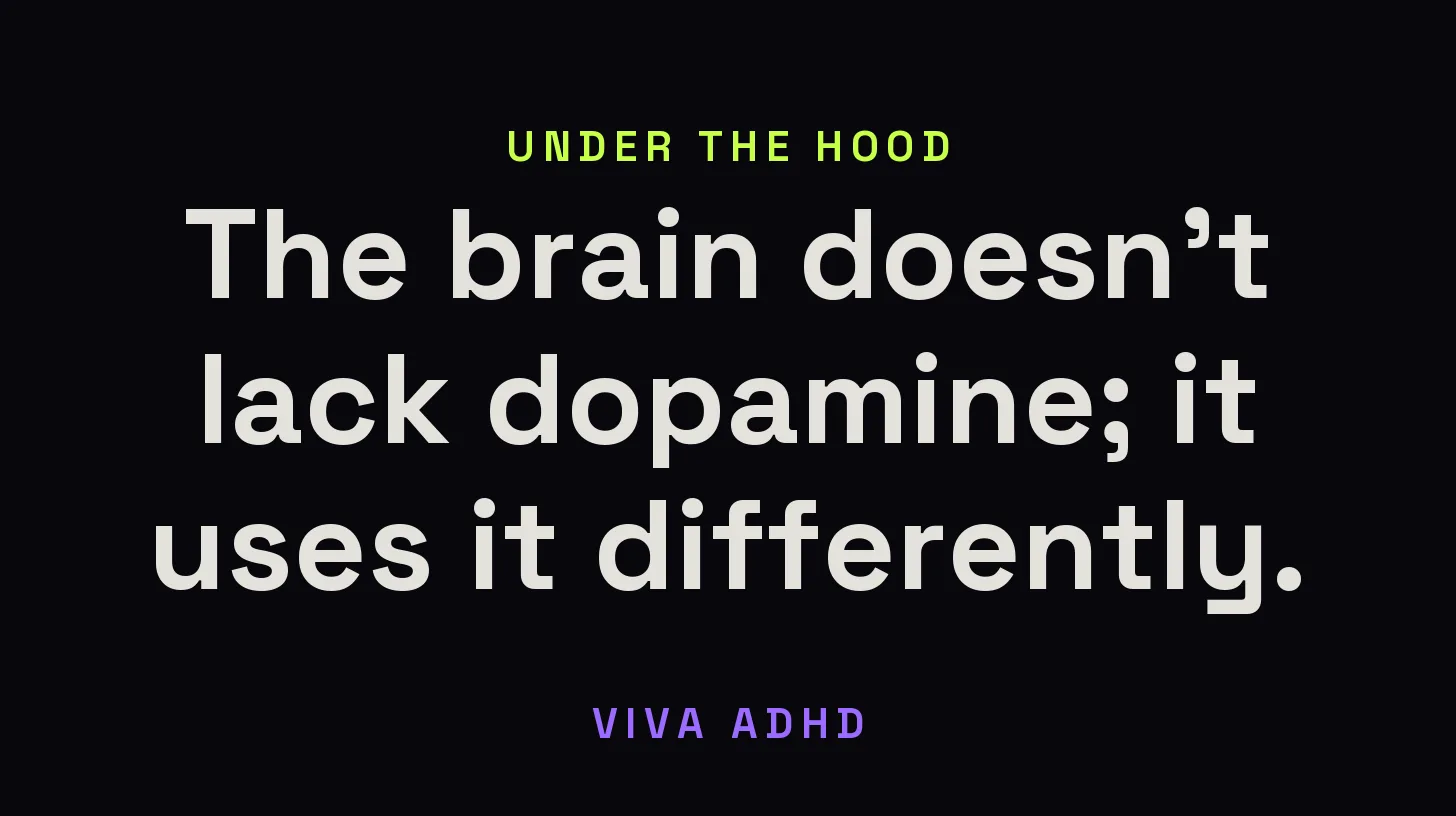
In a neurotypical brain, the dopamine system provides a baseline level of motivation that allows you to engage with tasks regardless of how exciting they are. Important but boring tasks still get done, because the dopamine system bridges the gap between "this matters" and "I can do this." In ADHD brains, that bridge is weaker. Nora Volkow and colleagues found that ADHD is associated with reduced dopamine signaling in the reward pathway, which means the brain has trouble generating motivation for low-stimulus tasks (Volkow et al., Journal of the American Medical Association, 2009; Volkow et al., Molecular Psychiatry, 2011). The brain doesn't lack dopamine; it uses it differently.
Here's where VAST adds understanding: the dopamine system in ADHD brains still works, but it's stimulus-gated. High stimulus opens the gate (novelty, urgency, interest, competition, hands-on activity). Low stimulus closes it (routines, paperwork, abstract future rewards, passive learning). The same person who can't read a two-page letter from the bank can spend four hours researching a hyperfixation because the stimulus is different, not because the effort is different. This is why ADHD is so misunderstood: the inconsistency looks like a choice, but it's a neurobiological response to stimulus levels. The impairment is real; the mechanism is visible.
Same brain, same day. The only variable is stimulus. VAST says: design for this, don't fight it.
3. VAST vs. ADHD: a new name, not a new condition.
VAST isn't a separate diagnosis from ADHD. It's a different way of describing the same neurobiology. ADHD (in the DSM-5) frames the condition as a deficit: attention deficit, hyperactivity disorder. VAST adds the mechanism: attention that varies based on stimulus. Same brain, different lens. The DSM label is what gets you a diagnosis and treatment; the VAST lens is what helps you understand why you can hyperfocus for nine hours on the right thing and can't start a ten-minute task on the wrong thing. Both are true. The deficit is real; the mechanism explains it.
The distinction matters practically. "Deficit" says something is missing; "variable" says something is conditional. If your attention is a deficit, the only fix is compensation (try harder, build systems, medicate). If your attention is stimulus-dependent, the fix includes design: changing the stimulus environment so your attention system can engage. Both approaches help. But the VAST lens gives you a lever the deficit lens doesn't: you can change the input, not just push harder on the output. (More on the dopamine mechanism in dopamine →.)
4. If you live here, these will land a little.
5. Change the stimulus. Don't push harder on a closed gate.
If your attention is stimulus-dependent, the fix isn't willpower; it's design. Each move below adds stimulus to a low-stimulus task so your dopamine system can engage. Pick the one that fits where you are right now.
Manufacture urgency
If only real urgency gets you moving, make some. Tell a friend you'll send them the photos by 5pm. Set a video call to show them the finished project. External accountability is a stimulus. Your brain responds to the social pressure the same way it responds to a real knock at the door, because the dopamine system doesn't distinguish between real and manufactured urgency.
Add novelty to routine
The same task in a new location, with new music, in a new order, or with a new tool is more stimulating to an ADHD brain. Novelty is a stimulus. You don't need a better system. You need a fresher version of the one you have. The brain that craves new things is telling you what it needs; give it something new.
Body double for stimulus
Another person in the room is a social stimulus. Their presence keeps the dopamine gate slightly more open. Body doubling works because it adds stimulus, not because it adds help. You don't need them to do anything. They just need to exist nearby. (More in body doubling →.)
Make it kinetic
ADHD attention systems engage with hands-on, physical, multi-sensory input more than abstract, passive input. If you can't get through the instructions, read them out loud while pacing. If you can't think through the problem, draw it on paper. Movement is a stimulus. The wiring isn't designed for stillness and silence.
Gamify the boring
Turn the task into a game: race the timer, count the items, track the streak. Competition and progress-tracking are stimuli. ADHD brains respond to measurable, visible progress the same way they respond to novelty, because both signal "something is happening," which is what the dopamine system needs to engage.
Match your stimulus window
ADHD brains have windows when the dopamine gate is more open: often after exercise, in the morning after medication, or during a novelty spike. Don't waste high-stimulus windows on high-stimulus tasks. Save the boring, low-stimulus work for when the gate is most open. The same task is easier at the right time, not just with more effort.
Don't push harder on a closed gate. Change the stimulus and the gate opens.
Quick answers.
Is VAST a real diagnosis? +
How is VAST different from ADHD? +
Who came up with VAST? +
Does VAST mean ADHD isn't real? +
Can you treat ADHD by changing stimulus instead of medication? +
The science under it.
Plain-language above, real research here. VAST is a proposed lens built on established neuroscience: the dopamine and attention research is real, the name is still a proposal. ADHD is a recognized disability; VAST explains the mechanism. Full library at /sources →
- Volkow ND, Wang G-J, Kollins SH, et al. (2009). "Evaluating dopamine reward pathway in ADHD." Journal of the American Medical Association, 302(10), 1084–1091. (reduced dopamine signaling in ADHD reward pathways: the neurobiological basis for stimulus-dependent attention)
- Volkow ND, Wang G-J, Newcorn JH, et al. (2011). "Motivation deficit in ADHD is associated with dysfunction of the dopamine reward pathway." Molecular Psychiatry, 16(11), 1147–1154. (the motivation gap as a dopamine system difference, not a character flaw)
- Barkley RA (1997). "Behavioral inhibition, sustained attention, and executive functions: Constructing a unifying theory of ADHD." Psychological Bulletin, 121(1), 65–94. (executive function as self-regulation; attention as a regulated system, not a fixed capacity)
- Hallowell EM, Ratey JJ (2021). ADHD 2.0: New Science and Essential Strategies for Thriving with Distraction, from Childhood through Adulthood. Ballantine Books. (where the VAST name was introduced; a proposed lens, not a diagnosis)
Viva is educational, not medical advice (Viva's a squirrel, not a doctor). This is how ADHD brains tend to work, plus what helps. If attention differences are affecting your life, a real clinician is worth it.
One pattern like this, every week.
The Dot Connector: one pattern, one tool, one "oh THAT'S why," straight to your inbox. No spam, no shame.
Unsubscribe anytime. Privacy · Terms · Accessibility · Educational content, not medical advice.
